Halftone Panel
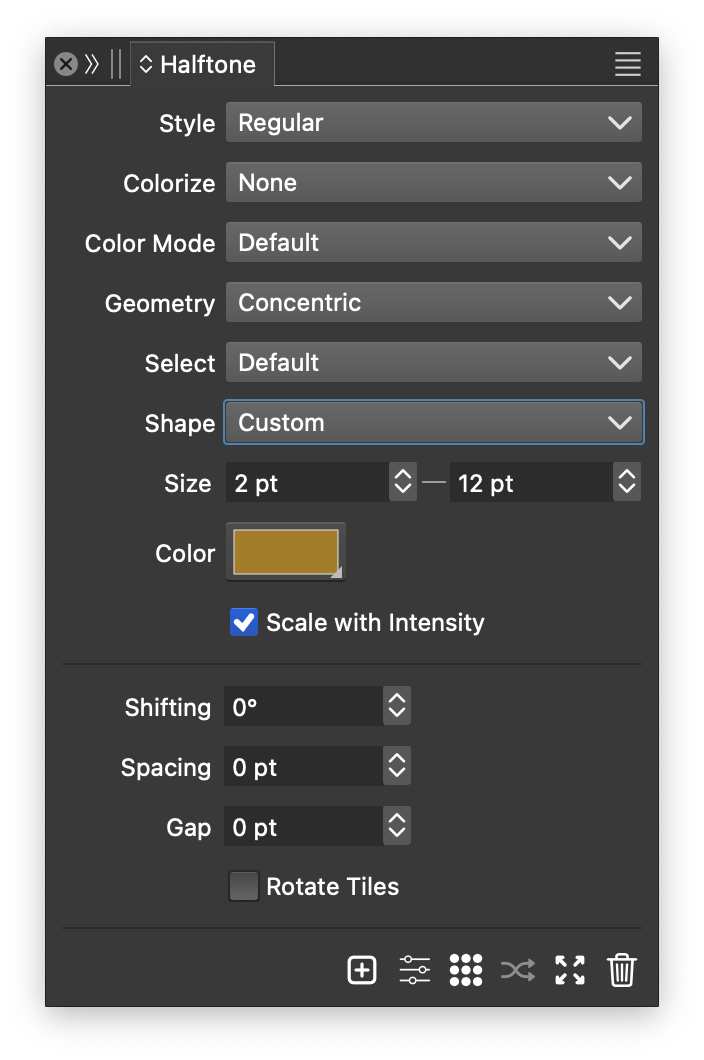
The Halftone panel.
Open the Halftone panel with the Halftone command or from Window - Effects. When you select an object with a halftone, the panel shows its current settings.
Panel Options
- Style - Choose a halftone type, or create and reuse halftone presets and styles.
- Colorize - Choose how dots or strokes are colored. Backdrop Content samples colors from the backdrop.
- Color Mode - Choose the color mode used to sample intensities, including individual color channels.
- Geometry - Choose, edit, or reuse a geometry type, style, or preset. Available for Regular, Width, and Overlay halftones.
- Select - Choose how to select between multiple dot shapes. Available for Regular and Stippling halftones.
- Shape - Choose the dot shape for Regular and Stippling halftones.
- Size - Set minimum and maximum dot sizes for Regular halftones.
- Color - Set the dot or stroke color.
The remaining controls depend on the geometry. See Halftone Options for details.
Panel Commands
The icon row provides these commands:
 - Add a halftone to the selected objects.
 - Open the Halftone Style dialog with the full set of options.
 - Apply the object’s shape effects to the halftone dots or lines. When disabled, only the object’s shape is distorted; the halftone fills that distorted shape.
 - Choose a new random seed for randomized settings.
 - Convert the halftone to editable shapes and objects.
 - Remove the selected object’s halftone.
Halftone Panel Menu
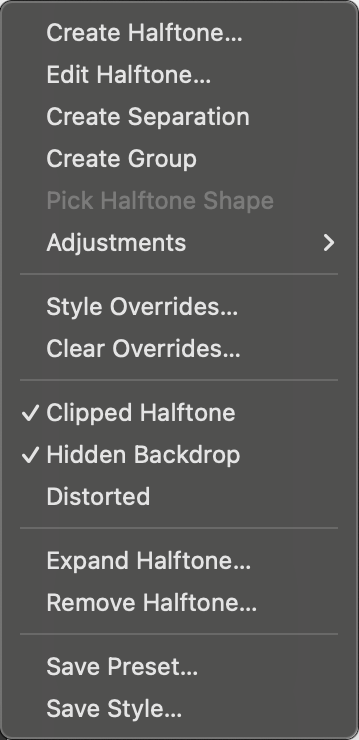
The Halftone panel menu.
- Create Halftone - Add a halftone to the selected objects.
- Edit Halftone - Open the Halftone Style dialog. See Halftone Options.
- Create Separation - Create a CMYK halftone group with a regular halftone for each channel.
- Create Group - Create a group of independent halftones on the same backdrop. See Halftone Groups.
- Pick Halftone Shape - Use shapes from the selected objects for a regular or width halftone.
- Adjustments - Open these additional controls:
- Adjust Tones - Edit the intensity adjustment function controlling dot size or stroke width.
- Backdrop Adjustment - Apply image filters to the backdrop before sampling it.
- Clear Backdrop Adjustment - Remove all backdrop image filters.
- Edit Distortions - Distort dot positions or paths used by width halftones.
- Corner Adjustments - Adjust shape corner rounding according to backdrop intensity.
- Remove Corner Adjustments - Remove corner adjustments.
- Offset Adjustments - Offset halftone shapes according to backdrop intensity.
- Remove Offset Adjustments - Remove shape offset adjustments.
- Style Overrides - Edit style and variable overrides applied to the halftone shape.
- Clear Overrides - Remove all style and variable overrides.
- Clipped Halftone - Clip dots or shapes to the object’s shape.
- Hidden Backdrop - Hide the object content below the halftone in the Appearance panel. Enabled by default.
- Save Preset - Save the current settings as a preset for use in other documents.
- Save Style - Save the current settings as a style for use in this document. Editing the style updates all its uses.
Selecting Shapes
Regular and Stippling halftones use closed shapes as dots. Replace them with shapes from the canvas.
Width and Overlay halftones use shapes to define their geometry. These can come from shape styles, presets, or the canvas.
To choose a shape:
- Save it as a shape style or preset, then choose it from the Shape dropdown.
- Copy and paste a shape from another object to use it as a dot.
- Use Pick Halftone Shape in the panel menu to assign one or more shapes from selected objects to the selected effect.


