Repeater Options
Edit detailed repeater settings in the Repeater Style dialog. Open it from the Repeater panel or choose Repeater Options from Styles - Repeater.
Use Style to choose a saved style or preset. Choose Create Style or Create Preset from the same list to save the current settings.
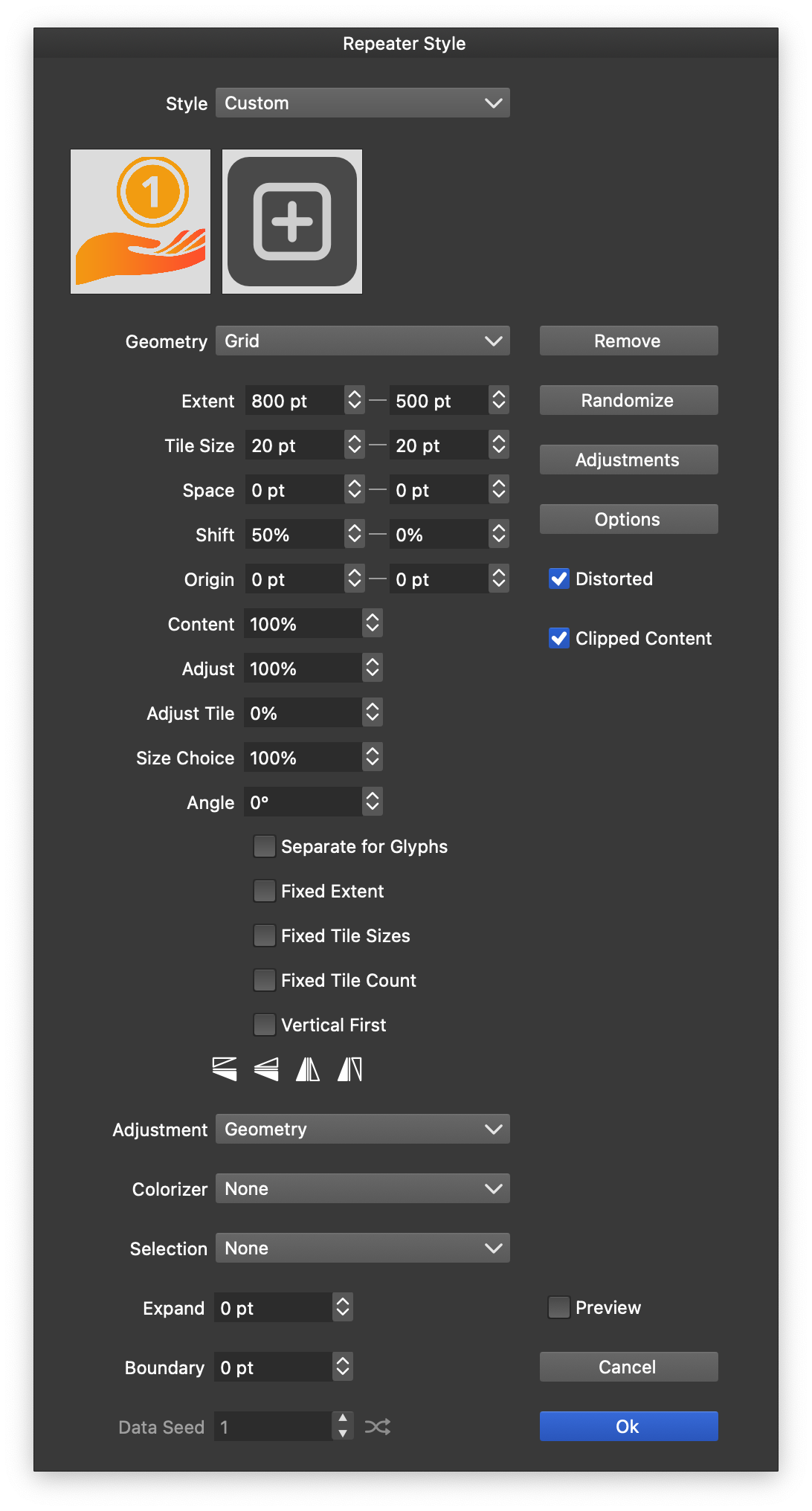
The Repeater Style dialog.
Managing the Symbols
The horizontal list below Style shows the source symbols and objects. Click an item to select it.
- Click the plus icon and choose a symbol to add it.
- Select a symbol and click Remove to remove it.
- Double-click a symbol to replace it with another from the menu.
Repeater Options
- Style - Create or reuse repeater presets and styles.
- Geometry - Choose a geometry type, preset, or style.
- Geometry options - The middle-left area contains settings for the selected geometry. See Geometries.
- Adjust Geometry - Choose or edit the geometry adjustments. See Adjustment.
- Colorizer - Choose or edit the colorization scheme. See Colorizer.
- Selection - Choose the randomization scheme for selecting between source symbols.
- Expand - Expand or shrink the repeater region inside a containing shape.
- Boundary - Expand or shrink the source shapes’ boundaries for collision detection in random repeaters.
- Data Seed - Set the data source randomization seed.
- Randomize - Change the repeater’s random seeds.
- Adjustments - Open the adjustment menu:
- Geometry Adjustments - Edit position, scale, and rotation adjustments. See Adjustment.
- Colorizer Options - Edit color adjustments. See Colorizer.
- Adjust Color Styles - Override color styles separately for each copy using a colorizer scheme and the copy’s position.
- Adjust Number Values - Override number variables for each copy using an intensity scheme to choose between minimum and maximum values.
- Adjust Opacities - Vary opacity with backdrop intensity.
- Adjust Tints - Vary color tints, including spot color tints, with backdrop intensity.
- Adjust Corner - Vary corner sizes with backdrop intensity.
- Adjust Offsets - Offset shapes by amounts controlled by backdrop intensity.
- Options - Open additional settings:
- Edit Distortions - Apply shape effects to repeater positions to create more complex arrangements.
- Data Source - Choose a document data source to override styles and variables in repeated objects. Create, import, and manage sources in the Data Source panel.
- Data Mode - Choose the order in which data rows are assigned to copies.
- Absolute Position - Use an absolute origin for the geometry. For grids, this aligns the tiles.
- Clipped Content - Clip repeated content to the containing shape.
- Hide Overlapped Appearance - Hide object content below the repeater in the Appearance panel. Enabled by default.
- Always Copy Objects - Create object copies even in basic repeater cases.
- Distorted - Apply the object’s shape effects to the repeated content. When disabled, only the containing shape is distorted; the content fills that shape.
- Inside Shape - Show only copies fully inside the containing shape.
- Restrict Using Shape - Use each copy’s actual shape to check whether it is inside the container.
- Random Symbols - Choose randomly between multiple source objects or symbols.
- Symbols by Backdrop - Choose between multiple source objects or symbols using backdrop intensity.
- Preview - Preview the current settings.
Adjusting the Color Styles
Use a separate colorizer for each color style in the source objects. Each copy receives an override based on its position. Choose Adjust Color Styles from the dialog’s Adjustments menu or the panel menu.
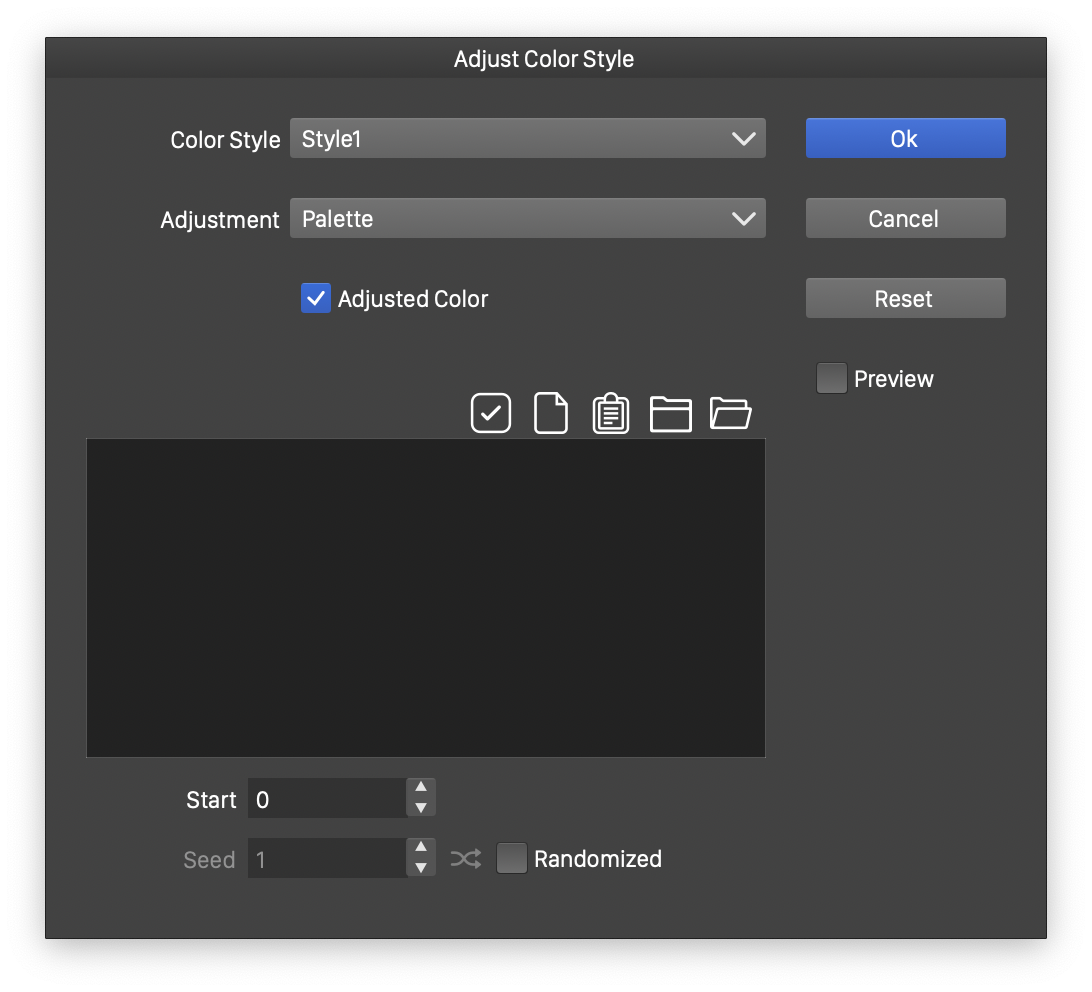
Color style adjustment options.
Choose a style from Color Style, then select its colorizer in Adjustment. If the source objects contain no color styles, the list is empty and this feature cannot be used. See Colorizer for details.
Available color sources are:
- Object Content - Sample the repeater’s backdrop.
- Noise - Generate colors from noise across the repeater.
- Gradient - Generate colors from a gradient across the repeater.
- Region - Sample another object with the Image for Effect role.
- Palette - Choose colors from a palette.
- Randomized - Generate random colors.
- Intensity - Blend between two colors using intensity values.
- Variations - Generate colors using variations.
Adjusting the Number Variables
Number variables can control stroke widths and other object, shape, or effect attributes inside a source symbol. Give each variable its own intensity scheme to generate a value for every copy, within a specified range.
Choose Adjust Number Values from the dialog’s Adjustments menu or the panel menu.
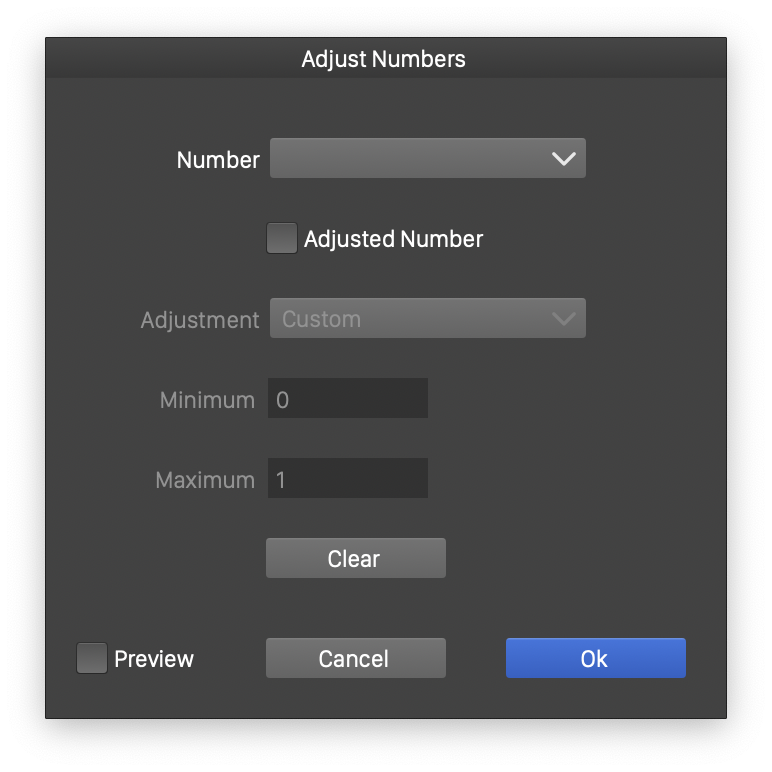
Number variable adjustment options.
Choose the variable in Number. If the source objects contain no number variables, this list is empty and the feature cannot be used.
- Adjusted Number - Enable intensity-based overrides for the selected variable.
- Minimum - Set the value used at minimum intensity.
- Maximum - Set the value used at maximum intensity.
- Adjustment - Choose or edit the intensity scheme. See Repeater Intensity.
- Clear - Remove all number variable adjustments.
Adjusting Opacities
Vary copy opacity with an intensity scheme. For example, use backdrop tone to reproduce an image with opacity changes. Choose Adjust Opacities from the dialog’s Adjustments menu or the panel menu.
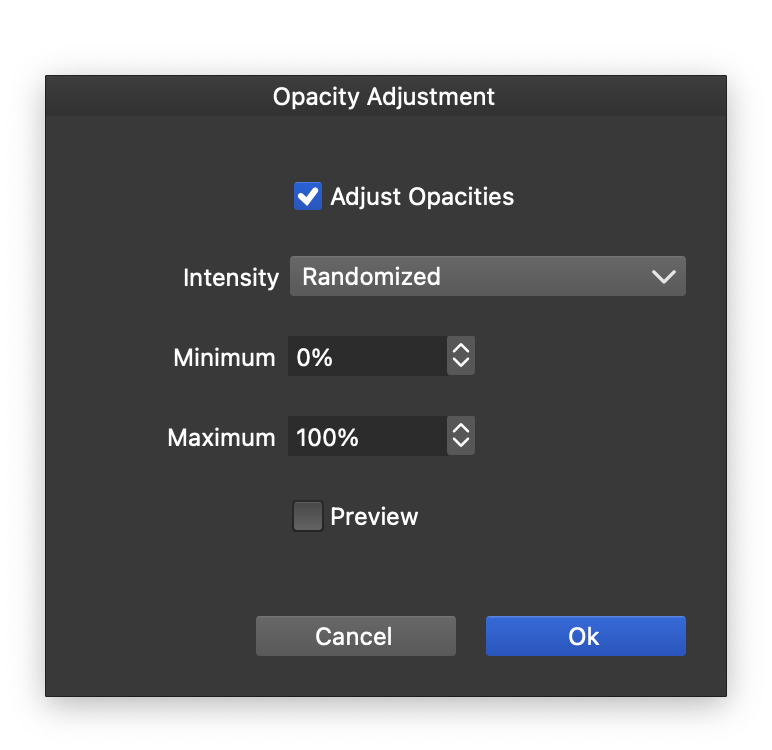
Opacity adjustment options.
- Adjust Opacities - Enable opacity adjustments.
- Intensity - Choose an intensity style or preset. See Repeater Intensity.
- Minimum - Set the minimum opacity.
- Maximum - Set the maximum opacity.
Adjusting Tints
Vary color tints with an intensity scheme, including backdrop tone. This works with any color and is especially useful for spot colors. Choose Adjust Tints from the dialog’s Adjustments menu or the panel menu.
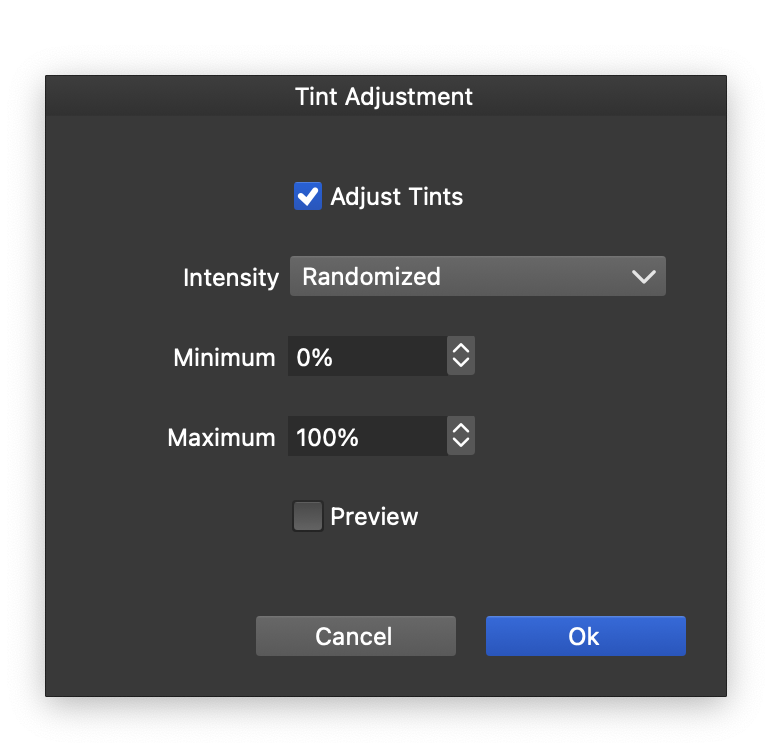
Color tint adjustment options.
- Adjust Tints - Enable tint adjustments.
- Intensity - Choose an intensity style or preset.
- Minimum - Set the minimum tint level.
- Maximum - Set the maximum tint level.
Adjusting Tones
Vary color tones with an intensity source and a tone adjustment scheme, similar to those in the Color Schemes panel. Choose Adjust Tones from the dialog’s Adjustments menu or the panel menu.

Color tone adjustment options.
- Adjust Tones - Enable tone adjustments.
- Intensity - Choose an intensity style or preset.
- Scheme - Choose a tone adjustment scheme.
- Minimum - Set the minimum tone level.
- Maximum - Set the maximum tone level.
Adjusting Corner
Vary corner sizes with an intensity scheme, for example to reproduce backdrop tones. Choose Adjust Corner from the dialog’s Adjustments menu or the panel menu.
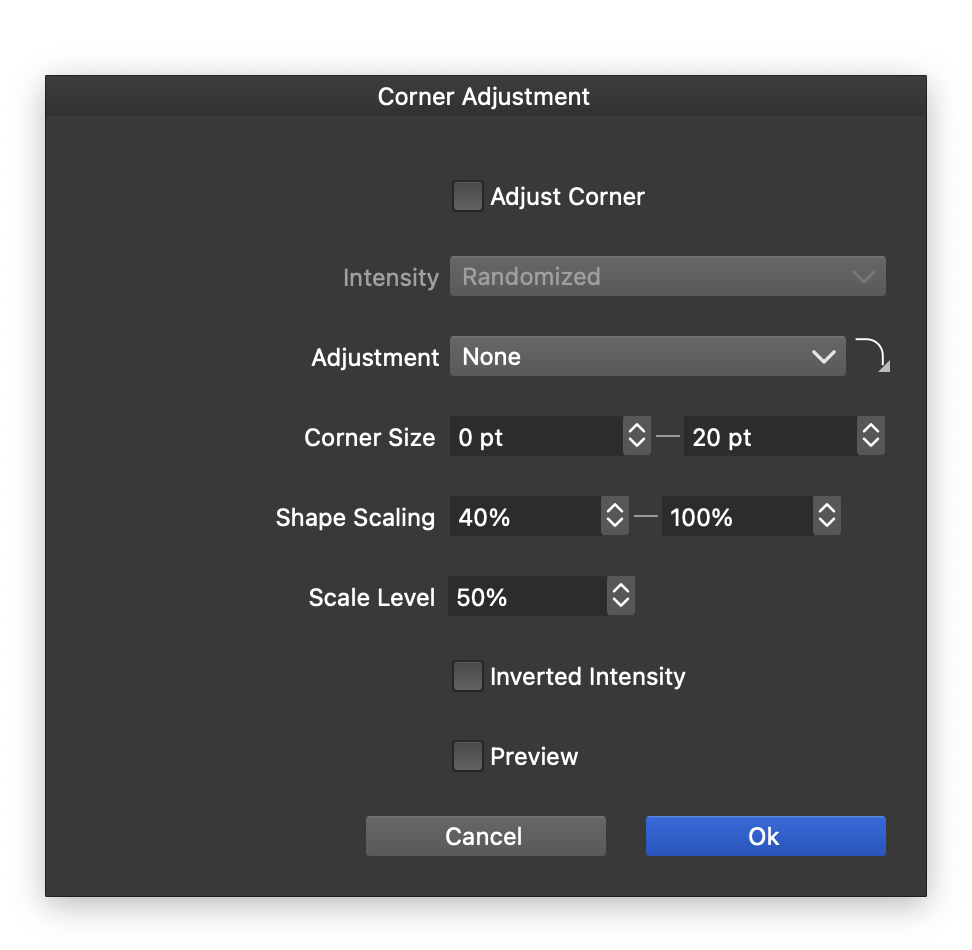
Corner size adjustment options.
- Adjust Corner - Enable corner size adjustments.
- Intensity - Choose an intensity style or preset.
- Adjustment - Choose or edit the response function that maps intensity to corner size.
- Corner Size - Set minimum and maximum corner sizes.
- Shape Scaling - Set minimum and maximum additional scaling amounts.
- Scale Level - Set the intensity below which scaling is also applied.
Adjusting Offsets
Vary shape offsets with an intensity scheme to create larger or smaller shapes. For example, use backdrop tone to control the offset. Choose Adjust Offsets from the dialog’s Adjustments menu or the panel menu.
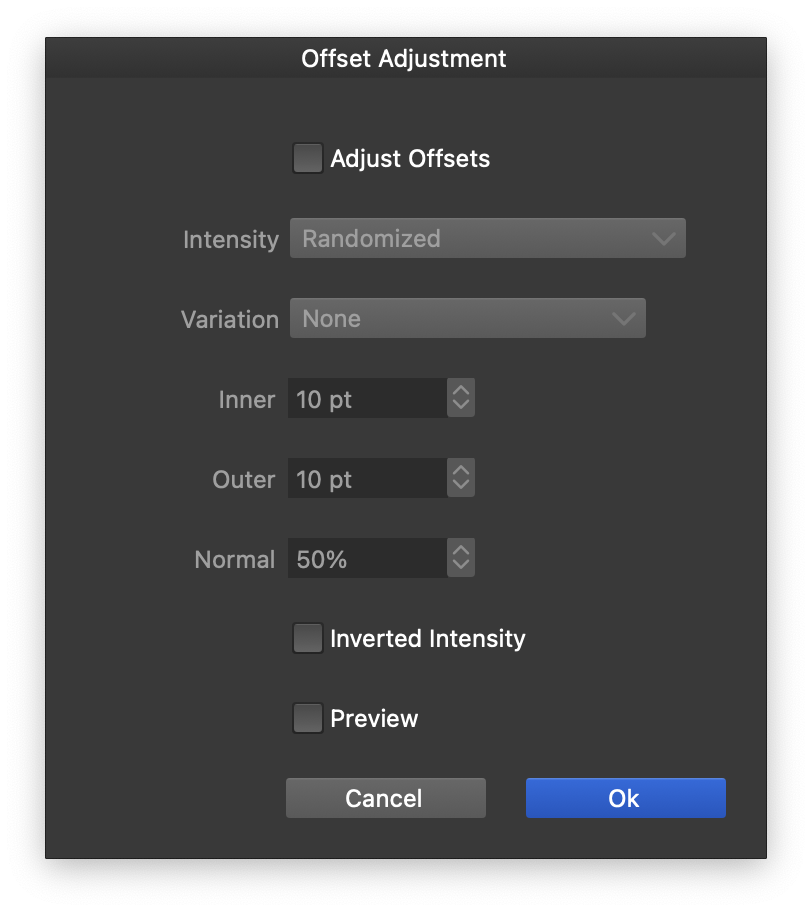
Shape offset adjustment options.
- Adjust Offsets - Enable shape offset adjustments.
- Intensity - Choose an intensity style or preset.
- Variation - Choose or edit the response function that maps intensity to offset size.
- Inner - Set the maximum inward offset.
- Outer - Set the maximum outward offset.
- Normal - Set the intensity at which shapes keep their original size, with no offset.


